The evolution of technological infrastructure no longer follows a linear path of replacement, but one of strategic convergence. In what we define as the Cloud Continuum, the mainframe has stopped being an isolated processing island and has become the anchor of security and performance within a hybrid mesh.
Far from being a “legacy to be removed,” the z/OS platform acts as the central node of trust, integrating seamlessly with cloud services to sustain critical operations that demand massive scale and absolute reliability. Mainframe modernization is now the foundation of corporate competitiveness.
Reconfiguring infrastructure: the mainframe as a strategic node
The idea that the mainframe is an obsolete technology ignores the operational reality of the global financial sector. Today, z/OS supports approximately 95% of banking transactions and credit card operations.
Modernizing the platform is a higher strategic priority than full migration, as the mainframe delivers processing capacity (MIPS) and resilience that public cloud environments still cannot replicate at the same scale for core business operations.
The “in-place modernization” strategy allows organizations to maintain transactional robustness while gaining the agility required for the new financial ecosystem.
The challenge now is to transform the mainframe into an agile, connected, and responsive component within the cloud continuum—ensuring that hardware performance keeps pace with software speed.
Open Finance and the low-latency challenge
The rise of Open Finance has imposed unprecedented pressure on core systems. Massive API-driven integration requires the z/OS back-end to respond in milliseconds.
Any bottleneck in this hybrid architecture—especially between cloud front-end layers and transactional legacy systems—results in degraded user experience and loss of market share.
To sustain this demand, the Mainframe positions itself around three technical pillars:
On-demand scalability: Ability to absorb massive processing spikes (PIX and seasonal transactions) without compromising SLAs
Chip-level encryption and AI: Innovations such as the IBM Telum II processor (z17) enable real-time AI inference directly at the silicon layer, essential for fraud prevention in Open Finance without adding latency
24/7 availability: Infrastructure designed for fault tolerance, keeping the digital ecosystem continuously active
This integration is only effective if the development cycle (DevOps) can match cloud speed—overcoming historical testing bottlenecks.
The DevSecOps paradox: why emulation fails
Reducing Time to Market (TTM) is the central goal of any modernization architect, yet testing remains the biggest obstacle, often representing up to 50% of total application cost.
In the pursuit of speed, many organizations still rely on outdated “emulated testing” approaches (fakes or mocks).
Technical analysis shows that emulation fails to capture logical conditionals (IF statements) and the complex interdependencies between real subsystems such as CICS, DB2, and IMS.
The cost of this oversight is catastrophic. The market has already seen severe incidents—such as the case of Itaú, which lost R$490 million in a single day after deploying an application without proper validation in a real environment.
Emulation does not replicate the complexity of a PIX transaction—it merely hides errors that will inevitably surface in production.
Eccox APT: turning parallel testing into financial efficiency
To resolve the conflict between speed and security, Eccox APT (Application for Parallel Testing) emerges as a disruptive tool for the Cloud Continuum.
Unlike mocks, APT uses isolated test tracks while maintaining access to real subsystems.
This ensures that developers validate code against production reality—not a simplified simulation.
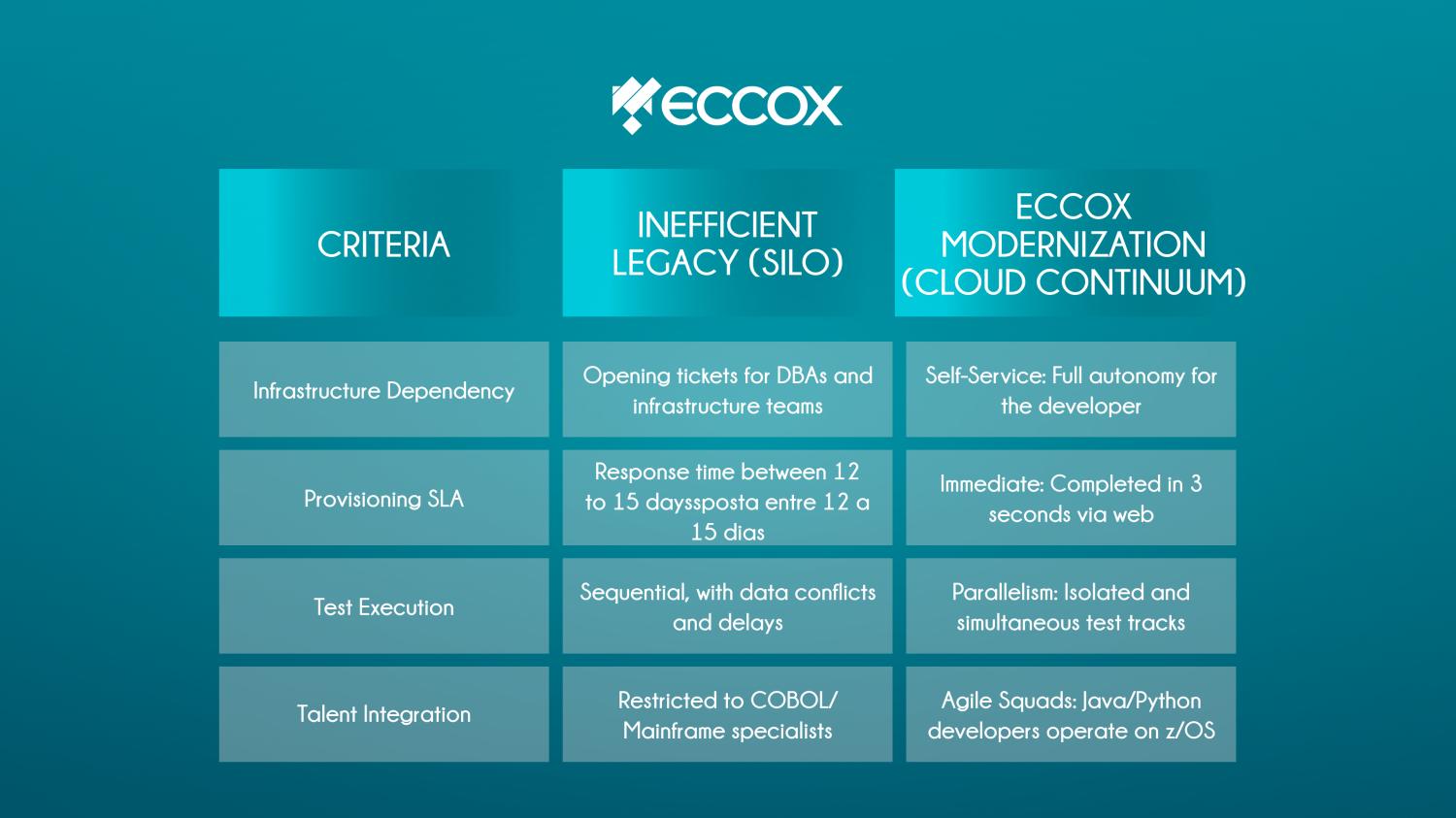
Modernization comparison: silo vs. Cloud Continuum
In addition to agility, Eccox APT efficiency directly impacts OPEX by drastically reducing MIPS consumption.
By optimizing testing cycles and resource usage, infrastructure aligns with sustainability and ESG goals for 2030, reducing energy waste from redundant processing.
ROI and success cases: tangible results for leadership
Mainframe testing modernization delivers measurable results that transform IT from a cost center into an efficiency engine. Audited results in major Brazilian institutions confirm the impact:
Bradesco: Environment provisioning time dropped from 1,192 hours to just 154 hours. Total project delivery time (TTM) was reduced by 88%, from 146 days to 18.35 days.
Itaú: Over 60% reduction in testing phases. Scenario provisioning, which previously required 480 hours from three professionals over four weeks, is now completed in just 2 hours.
Operational efficiency: The end of ticket-driven processes allows infrastructure to respond to business demand in seconds, not weeks.
Mainframe modernization is not the end of the platform—it is its evolution into the state of the art of hybrid computing.
In 2025, z/OS should not be seen merely as a maintenance cost, but as a high-performance node within the Cloud Continuum.
Infrastructure leaders must abandon legacy testing approaches that generate multimillion-dollar risks.
By adopting parallelism and the self-service model enabled by Eccox APT, organizations eliminate bottlenecks, integrate new talent, and ensure that the transactional core of their business keeps pace with digital innovation.
If your mainframe is already part of your cloud strategy, the next step is not expansion—it’s intelligent integration.
Talk to Eccox and see how to evolve your architecture into the Cloud Continuum, eliminating bottlenecks, reducing risk, and connecting performance to the agility your business demands.


About Post Author