What to Expect from Mainframe Modernization in 2026?
The year 2025 marked a turning point where the euphoria of “cloud at any cost” gave way to pragmatic hybrid architectures.
After years of failed full-scale migration attempts, corporations have come to understand that the mainframe is not a relic of the past, but an indispensable core of trust in a data-saturated ecosystem.
With the advent of next-generation hardware, such as the IBM z17 equipped with Telum II processors, the platform has expanded its capabilities for real-time AI inference and cybersecurity—reinforcing why it supports the operations of 75% of Forbes companies and 95% of the global financial sector. Technological inertia has become an unacceptable risk.
The mainframe modernization market, projected to reach $12.77 billion by 2032 with a CAGR of 9.39%, reflects the urgency for IT agility and cost efficiency.
The simplistic view of “total replacement” has failed in the face of mission-critical complexity. From a strategic perspective, modernization means evolving legacy systems to operate with DevOps-like fluidity while maintaining the sovereign resilience of z/OS. This transition is driven by the unprecedented transactional pressure of the digital economy.
The “Mobile Effect” and Pressure on Critical Transactions (PIX and Mobile)
The “mobile effect” has reshaped the economics of processing. The exponential growth in mobile queries and transactions places pressure on infrastructure without generating immediate new revenue.
In Brazil, the widespread adoption of PIX has led to a 35% increase in MIPS consumption—an operational cost increase that is “non-revenue generating” and demands strict optimization of the batch window.
If overnight processing windows are not optimized, institutions risk systemic freeze, preventing the start of the next business day.
Modernization, therefore, becomes an operational survival imperative. Failures in high-volume environments have already demonstrated the severity of this scenario, with multiple cases reported by the media.
The Application Dilemma: Refactoring, Rehosting, or AI?
Organizations are dealing with complex monolithic systems. In 2026, modernization approaches have become more pragmatic:
Automated Refactoring
- Tools like AWS Blu Age and IBM watsonx Code Assistant convert COBOL into Java. However, technical skepticism remains essential: AI still struggles to fully understand non-standard complex logic and requires rigorous human review to ensure security.
Replatforming
- An approach that moves workloads to modern environments with minimal changes, aiming for faster scalability gains.
- The real disruption lies in the validation phase. There is a strategic distinction between “emulated testing” and “real testing.” Emulation tools (such as those from IBM, BMC, or Micro Focus) often fail to capture interdependencies of JZOS and CICS APIs, leading to syntax and integration errors that only surface in production.
Eccox APT: Disruption in the Development Lifecycle (DevSecOps)
Eccox Technology positions itself as an authority that understands the true bottleneck is not coding, but testing and validation in parallel environments. The development lifecycle (DevOps) in mainframe environments often stalls due to data conflicts and limitations of physical environments.
The Eccox APT (Application for Parallel Testing) solution enables true parallelism through logical containers in z/OS.
This technology allows developers to operate in isolated “test tracks,” without the risk of data contamination or dependency on infrastructure scheduling.
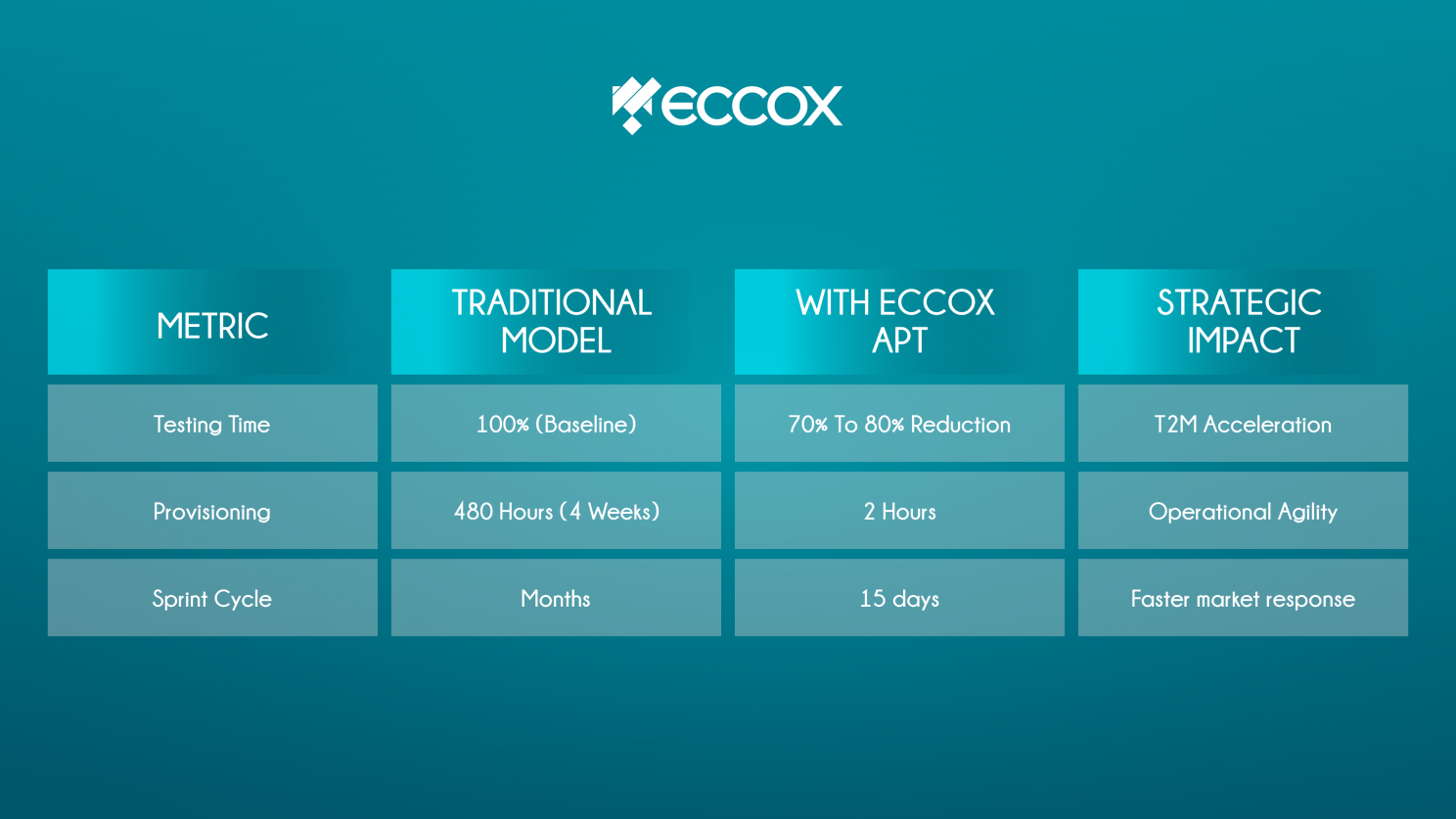
APT enables professionals with “decentralized skills” (Java, Python) to operate within the z/OS ecosystem via a self-service interface, eliminating the bottleneck of legacy-specialized talent.
Want to understand how APT can support your cost-reduction strategy? Talk to one of our specialists.
The ROI of Modernization: Real Cases and Strategic Value
Tangible results from large institutions confirm the sustainable value of this modernization:
Eccox Case with Banco Mercantil
1. Direct productivity gains and bottleneck elimination
- End of the 21-hour wait: Before Eccox, preparing a testing environment took an average of 21 hours. The solution enabled on-demand, instant test track creation—returning those hours to productive coding and business output.
- Faster delivery: Nearly 50% of users reported a noticeable 26% to 50% increase in delivery speed for new products and services.
2. Drastic reduction in rework (man-hour savings)
- 75% reduction in wasted time: The bank recorded over a 75% reduction in time previously spent fixing errors caused by environment conflicts.
- Broad impact: Nearly 85% of users (developers and QA teams) reported reduced rework, proving efficiency gains across the operation.
3. Infrastructure cost optimization (Mainframe/MIPS)
- Efficiency without new investments: Mainframe processing is historically expensive. Eccox’s solution enabled much smarter use of existing infrastructure.
- Reduced computational waste: By minimizing rework and code collisions in shared environments, the bank avoided unnecessary MIPS consumption—creating structural cost optimization and direct IT savings.
4. Business impact (Revenue generation and Time-to-Market)
- Faster product launches: Eliminating validation queues between technology and business teams enabled the bank to launch new credit policies and products faster, accelerating revenue generation ahead of competitors.
5. Risk mitigation and incident reduction
- Full isolation of test tracks (each with its own code and database): Enabled large-scale simultaneous testing without data corruption. This reduced incidents and increased system predictability, avoiding financial losses and reputational damage from core banking failures.
- Human capital optimization: With automation and increased autonomy (over 150 professionals trained in the new model), teams shifted from operational bottlenecks to higher-value activities, optimizing IT labor costs.
ROI Summary: The investment in Eccox’s solution paid off by enabling Banco Mercantil to do more (large-scale parallel testing), faster (up to 50% speed gains), with the same infrastructure (no new mainframe investments), and with far fewer errors (75% reduction in rework).
The Modern Mainframe as a Long-Term Asset
Mainframe modernization in 2026 is a strategic imperative for agility and security. The mainframe must be treated as a long-term asset—capable of sustaining continuous innovation without sacrificing the resilience required for mission-critical transactions.
Eccox Technology positions itself as a key strategic partner, offering an end-to-end consultative approach.
Modernization strategies developed in São Paulo (Brazil) are now exportedworldwide, proving that Brazilian banking engineering is a global benchmark for technical efficiency.
For IT leaders, the focus must be on eliminating chronic operational inefficiencies to enable long-term business sustainability.


About Post Author